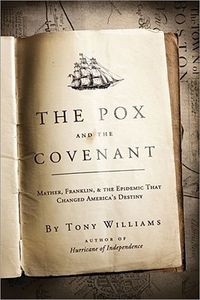
The Pox and the Covenant: Mather, Franklin, and the Epidemic That Changed America's Destiny
A History, Nonfiction book. Black seamen - or "Black Jacks" as African sailors were known - enjoyed a refreshing world of...
For one hundred years, God had held to his promise, and the colonists had as well. When the first Puritans sailed into Massachusetts in the seventeenth century, weak from the ocean journey, they formed a covenant with each other and with God to establish a city on a hill-a commitment to live uncorrupted lives together or all suffer divine wrath for their collective sin. But now, a century later, the arrival of one doomed ship would put this covenant to its greatest test. On April 22, 1721, the HMS Seahorse arrived in Boston from the West Indies, carrying goods, cargo, and, unbeknownst to its crew, a deadly virus. Soon, a smallpox epidemic had broken out in Boston, causing hundreds of deaths and panic across the city. The clergy, including the famed Cotton Mather, turned to their standard form of defense against disease: fasting and prayer. But a new theory was also being offered to the public by the scientific world: inoculation. The fierce debate over the right way to combat the tragedy would become a battle between faith and reason, one that would set the city aflame with rage and riot.The Pox and the Covenant is...
Download or read The Pox and the Covenant: Mather, Franklin, and the Epidemic That Changed America's Destiny in PDF formats. You may also find other subjects related with The Pox and the Covenant: Mather, Franklin, and the Epidemic That Changed America's Destiny.
- Filetype: PDF
- Pages: 277 pages
- ISBN: 9781402236051 / 0
BytZaQ_Oh8W.pdf
More About The Pox and the Covenant: Mather, Franklin, and the Epidemic That Changed America's Destiny
The Mayflower sped across the white-tipped waves once the voyage was under way, and the passengers were quickly afflicted with seasickness. The crew took great delight in the sufferings of the landlubbers and tormented them mercilessly. "There is an insolent and very profane young man, Bradford wrote, "who was always harrassing the poor people in their sickness, and cursing them daily with greivous execrations." He even laughed that he hoped to 'throw half of them overboard before they came to their journey's end.' The Puritans believe a just God punished... Black seamen - or "Black Jacks" as African sailors were known - enjoyed a refreshing world of liberty and equality. Even if they were generally regulated to jobs such as cooks, servants, and muscians and endured thier fellow seamen's racism, they were still freemen in the Royal Navy. One famous black sailor wrote, "I liked this little ship very much. I now became the captian's steward, in which I was very happy; for I was extremely well treated by all on board, and I had the leisure to improve myself in reading and writing. Tony Williams, The Pox and...
Interesting and lively account of smallpox epidemic in Puritan Boston and debate among Mather, Franklin and various others on vaccination and the role of the church. Williams has no trouble bringing this period to life but his depiction of Cotton Mather as a man of science and reason taking on the superstitious peasantry is simply bizarre... In 1721, the scourge of smallpox was back in Boston, but this time, Rev. Cotton Mather was determined to offer an alternative to accepting the disease as God's punishment--an inoculation procedure commonly used on Africans and Ottoman subjects (heathens! infidels!), and replicated by Dr. Boylston with success (although with some serious... Starts out excellent and then bogs down in too much detail.